KIEZWERKSTATT is based in Wedding, Berlin, and is run by the two of us: Vittoria Caradonna and Marta Manzuoli.
We come to the project from research and spatial design respectively, and we both live in the neighborhood where the project takes place. We first worked together on an art exhibition in Berlin, and the conversations between us quickly extended beyond the project itself, circling questions about place, memory, and our experiences with the culture world in the city, and beyond.
KIEZWERKSTATT grew out of those overlapping conversations: a recognition that we were asking the same questions from different sides, and that we worked well together when we did.
who we are
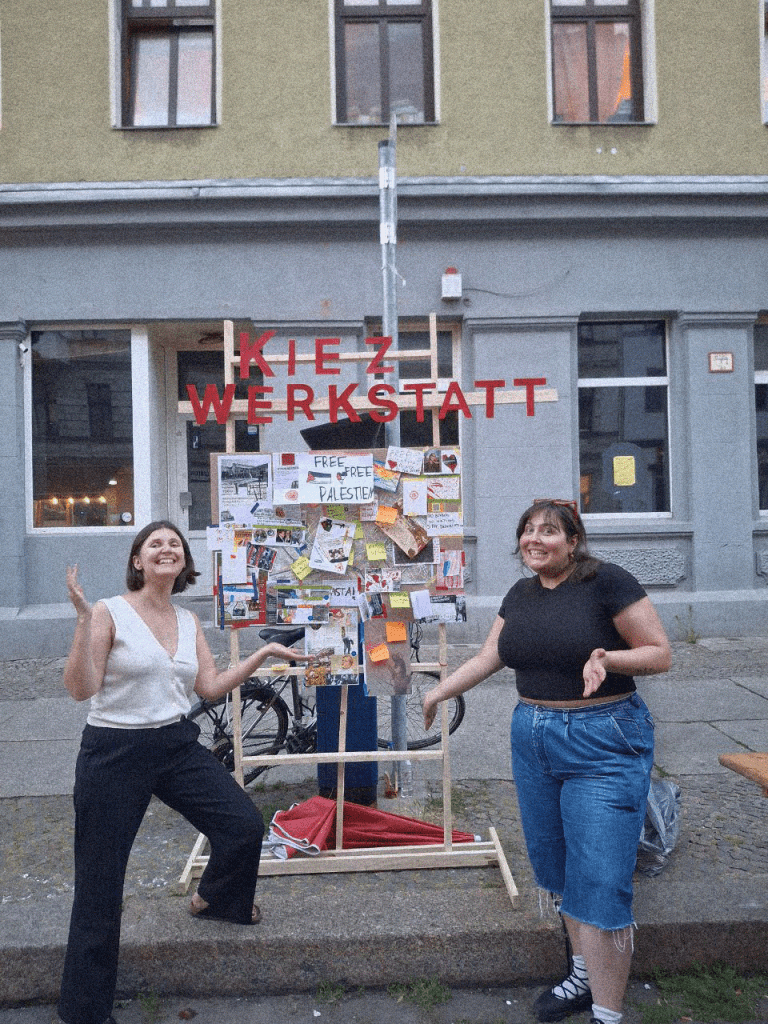
Vittoria Caradonna‘s practice bridges academic research and decolonial pedagogy, and seeks to unsettle dominant narratives about how the past is remembered and used in the present. She holds a Ph.D. from the University of Amsterdam, where she explored the nexus between colonial memory and migrant and anti-racist activism in institutional and grassroots contexts. Since relocating to Berlin, she has worked as a freelance consultant and evaluator, alongside her work on KIEZWERKSTATT. Her writing has appeared in peer-reviewed journals such as the International Journal of Heritage Studies and the International Journal of Urban and Regional Research, as well as in cultural criticism magazines such as roots§routes.
Marta Manzuoli is a spatial designer working at the intersection of architecture, exhibition-making, and dramaturgy. Her practice engages with how memory and history are spatially encoded in specific sites, often turning to disused, contested, or overlooked places. Across institutional and grassroots contexts, she has contributed to exhibitions and cultural projects in Europe and beyond, from Hamburger Bahnhof and the Lern- und Gedenkort Kaßberg in Chemnitz to projects within the b100 – Bauhaus centenary celebrations, often working through interactive and exploratory exhibition formats that invite visitors to test, try, and play their way through complex content while keeping it spatially and emotionally accessible. Alongside this cultural work, she works independently across brand, retail, office, and residential projects in Berlin and beyond, and co-founded KIEZWERKSTATT to extend these questions into the everyday urban fabric.
how we work
We work collaboratively through every stage of a project, each bringing our own perspective. Vittoria comes from a research and academic background and has a strong feel for the affective register of a situation: what a room holds, what’s unspoken. Marta works conceptually and dramaturgically across spatial questions, with a strong practical and logistical sense for how things get built and held together. We each have a foot in the other’s territory, which is what makes the collaboration work well.
We try to be intentional about what we do and how we do it. That means checking our ideas from different angles before putting them out, to make sure they say what we mean them to say. It also means being attentive to who is in the room, naming where each of us is speaking from rather than pretending to a neutral voice, and treating every formal choice (a zine, a panel, a walking tour or a workshop) as a decision that carries meaning. Part of being intentional, for us, is also choosing what to leave unfinished: not everything needs to be resolved, and some of the most useful things we make are deliberately fragmentary.
At the same time, we care a lot about being true to ourselves, and we’re not interested in polished outcomes. Whether we’re planning, presenting, or moderating, we want to keep a spontaneity that feels honest and lets other people feel comfortable enough to co-explore with us. For us this isn’t only a stylistic preference; it’s part of how we try to dismantle hierarchies and stay accessible. The intentionality and the spontaneity are not in tension; careful thought about the structure is what allows for freedom within it.
 KIEZWERKSTATT